
Student retention is one of the most complex challenges in higher education. Nearly one in four university students in the United States does not return for their second year. In the UK, dropout rates vary significantly by institution and subject, with some programmes losing more than 20% of students before completion.
The reasons students leave are rarely simple. Financial pressure, mental health, family circumstances, a sense of not belonging, and academic difficulty all play a role. No single tool or intervention resolves all of these. However, institutions that act early, before a student has already decided to leave, consistently achieve better outcomes than those that wait for academic performance to deteriorate.
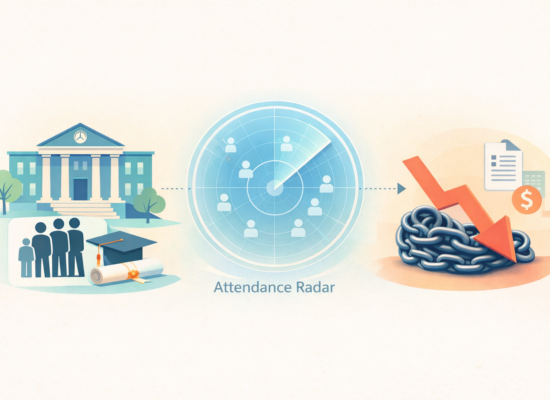
This is where attendance tracking becomes relevant. Not as a solution to retention in itself, but as an early signal. When a student who previously attended every session starts missing class, something has changed. That change may reflect disengagement, personal difficulty, or the beginning of a decision to leave. Attendance tracking makes that signal visible.
Why student retention matters so much right now
Retention affects universities financially and reputationally. In the UK, the Office for Students monitors continuation rates closely, and institutions with persistently high dropout rates face scrutiny. In the US, federal reporting requirements mean retention data is publicly visible, influencing rankings, funding, and prospective student decisions.
For students themselves, the consequences of dropping out are significant. Research from the Education Data Initiative shows that college dropouts are 20% more likely to be unemployed compared to those who complete their degrees (Education Data Initiative, 2024). Students who leave also carry the debt of their time enrolled without the qualification that makes it worthwhile.
For a closer look at the financial impact of student dropout on both institutions and students, see The cost of dropouts for universities and students.
The link between attendance and dropout risk
Research consistently shows that poor class attendance is one of the strongest behavioural predictors of dropout. A European study coordinated across 16 institutions involving nearly 10,000 university students found that class attendance was directly associated with whether students completed their degree or dropped out (Figuera et al., Frontiers in Psychology, 2016). Students who persisted attended more consistently. Students who dropped out showed measurable attendance decline before they left.
This matters because attendance typically changes before other indicators do. A student’s GPA may hold steady for weeks while they are quietly disengaging. Assignment submission patterns can mask early withdrawal because students may still turn in work while stopping attending altogether. Attendance, however, drops early. It is often the first visible sign that something is wrong.
Furthermore, the research suggests that the relationship runs in both directions. Regular attendance is associated with better academic performance, which in turn is associated with persistence. For more on this, see The impact of student attendance on academic performance.
However, it is important to be clear about what attendance data does and does not tell you. A student missing class may be dealing with a health issue, a family crisis, financial stress, or a growing sense of disconnection from their programme. The absence is a signal. The cause requires a conversation. Attendance tracking creates the condition for that conversation to happen earlier.
Why attendance data is underused as a retention tool
Most universities collect some form of attendance data. However, very few use it systematically as a retention input. Several structural problems explain this gap.
- First, data is siloed by instructor. A student missing three courses simultaneously may be flagged by none of their lecturers individually, because each one sees only their own register. No one has the full picture unless data is aggregated centrally.
- Second, manual attendance methods produce records that are not designed for analysis. A paper sign-in sheet or a spreadsheet kept by an individual instructor is not accessible to an academic advisor in real time. By the time the data reaches someone who can act on it, weeks may have passed.
- Third, there is often no defined threshold or workflow. Even institutions that collect accurate attendance data sometimes have no agreed point at which it triggers an action. Without a process, the data sits unused.
In addition, the quality of manual records is frequently unreliable. Proxy attendance, transcription errors, and inconsistent recording practices across departments mean the data may not accurately reflect who is actually in the room. For more on these limitations, see What is the best way to track student attendance?
What early intervention actually looks like
The institutions achieving the best retention outcomes are not necessarily those with the most sophisticated technology. They are the ones with a clear, agreed process for acting on early signals.
A 2024 survey from Trellis Strategies found that 15% of students missed class sometimes due to a lack of reliable transportation, and that among working students, one in four regularly missed class due to conflicts with work schedules (Trellis Strategies, 2024, via Inside Higher Ed). These are not academic problems. They are practical ones. An advisor who receives an attendance alert for a student in this situation can have a very different conversation than one waiting for a failed assignment or a missed exam.
Missouri State University demonstrated this clearly. The university identified students with lower GPAs who were also missing academic advisor appointments. After targeted outreach (moving from email to direct text contact) the university boosted fall-to-fall retention by one percentage point, effectively preventing 32 students from stopping out in a single year (Modern Campus, 2026). The intervention was not complex. What made it work was having the data early enough to act.
Similarly, a project at Strayer University involving faculty interventions based on engagement and attendance data resulted in a 5% increase in class attendance, a 12% increase in course pass rates, and an 8% decrease in course drops (Inside Higher Ed, 2016). Again, the technology was not the intervention. The advisor or faculty member reaching out was the intervention. The data simply made it possible sooner.
Therefore, the question for most institutions is not whether to invest in a complex analytics platform. It is whether the right people can see attendance patterns across courses, at the right time, with enough consistency to act.

What attendance data needs to look like to be actionable
For attendance tracking to support student retention, the data it produces needs to meet a few practical requirements.
It needs to be timely.
Retention interventions become significantly less effective as time passes. A student flagged after two consecutive weeks of absence is far easier to re-engage than one flagged after six. The data needs to surface quickly, ideally within days of a session, not at the end of a module.
It needs to be accurate.
Data based on proxy attendance, sign-in sheets, or inconsistent manual recording is not reliable enough to base welfare interventions on. Incorrectly flagging a student who was present as absent can damage the trust that makes outreach effective.
It needs to be consistent across courses.
An advisor trying to identify at-risk students needs data in a comparable format across every course a student is enrolled in. If each lecturer records attendance differently, aggregating it is practically impossible.
It needs to reach the right people.
Attendance data held by individual instructors does not support institutional retention efforts. It needs to be exportable and shareable with academic advisors, student success teams, and support services in a format they can use without significant reformatting.
These requirements are difficult to meet with manual methods. They are straightforward to meet with automated attendance tracking. For more on what to look for in a system, see Attendance tracking software for universities: how to choose the right system.
How Attendance Radar supports student retention efforts
Attendance Radar does one thing well: it produces a fast, accurate, and consistent attendance record that is accessible beyond the individual instructor.
Each session generates a timestamped record tied to individual student accounts. Instructors can export that data to Excel at any point, making it straightforward to share with advisors or student success teams without manual reformatting. For institutions using the University version, attendance data feeds directly into LMS and student information systems, where it can be viewed alongside other engagement signals.
The check-in process itself is Bluetooth-based for in-person sessions, meaning the records reflect verified physical presence rather than a sign-in sheet that could have been completed by someone else. For online and hybrid sessions, the manual code fallback provides a comparable record. For more on how this works in practice, see Attendance tracking for hybrid and online university courses: a practical guide.
Attendance Radar is not a retention platform. It does not send automated alerts to advisors or integrate with case management systems out of the box. What it does is produce the reliable, exportable attendance data that makes those processes possible. The intervention still depends on the people and the processes the institution puts around the data.
Universities including Tilburg, Indiana Wesleyan, Antwerp, and IESE Business School use Attendance Radar across teaching formats ranging from small seminars to large lecture halls and MBA programmes.
Attendance Radar is free to download and use. The Premium tier at $9 per month adds recurring sessions, course archives, and detailed attendance reports. University plans include administrator accounts, multi-instructor support, and LMS integration.

Frequently asked questions
What is the link between attendance and student retention?
Research across multiple European and US institutions shows that poor class attendance is one of the strongest early behavioural predictors of dropout. Attendance typically drops before GPA or assignment submission patterns shift, making it a leading indicator of withdrawal risk rather than a lagging one.
How can universities use attendance data to identify at-risk students?
By aggregating attendance records across courses and making them accessible to academic advisors or student success teams. When a student’s attendance drops significantly, or when they are absent from multiple courses simultaneously, that pattern can trigger an early outreach conversation before the situation escalates.
What attendance threshold should trigger an intervention?
This varies by institution and policy. However, most university attendance policies set a concern threshold between 70 and 80% of scheduled sessions. Two consecutive weeks of unexplained absence is a commonly used trigger for initial outreach. For more on how to set this out formally, see How to write a university attendance policy (with examples).
Does attendance tracking improve retention on its own?
No. Attendance tracking produces a signal. Retention improves when that signal reaches someone who can act on it; an advisor, a personal tutor, a student success coordinator. The tracking is the beginning of the process, not the end.
How do advisors access attendance data across multiple courses?
This depends on the system in use. With Attendance Radar, instructors can export session records to Excel and share them with advisors or administrators. The University version integrates directly with LMS and student information systems, allowing attendance data to be viewed centrally alongside other student engagement information.
The bottom line
Attendance tracking does not solve student retention. The reasons students leave university are too varied and too personal for any single tool to address. However, a student whose attendance is declining is sending a signal, and institutions that see that signal early are better placed to respond than those that wait for a missed exam or a failed module.
Reliable attendance data gives advisors and student success teams the information they need to start a conversation sooner. That conversation may be about transport, work schedules, mental health, academic difficulty, or simply a sense of not fitting in. Whatever the cause, earlier is better.
Try Attendance Radar for free today.
For more on the relationship between attendance and student outcomes, see How attendance affects graduation: what research shows and Strategies to improve student attendance in higher education.