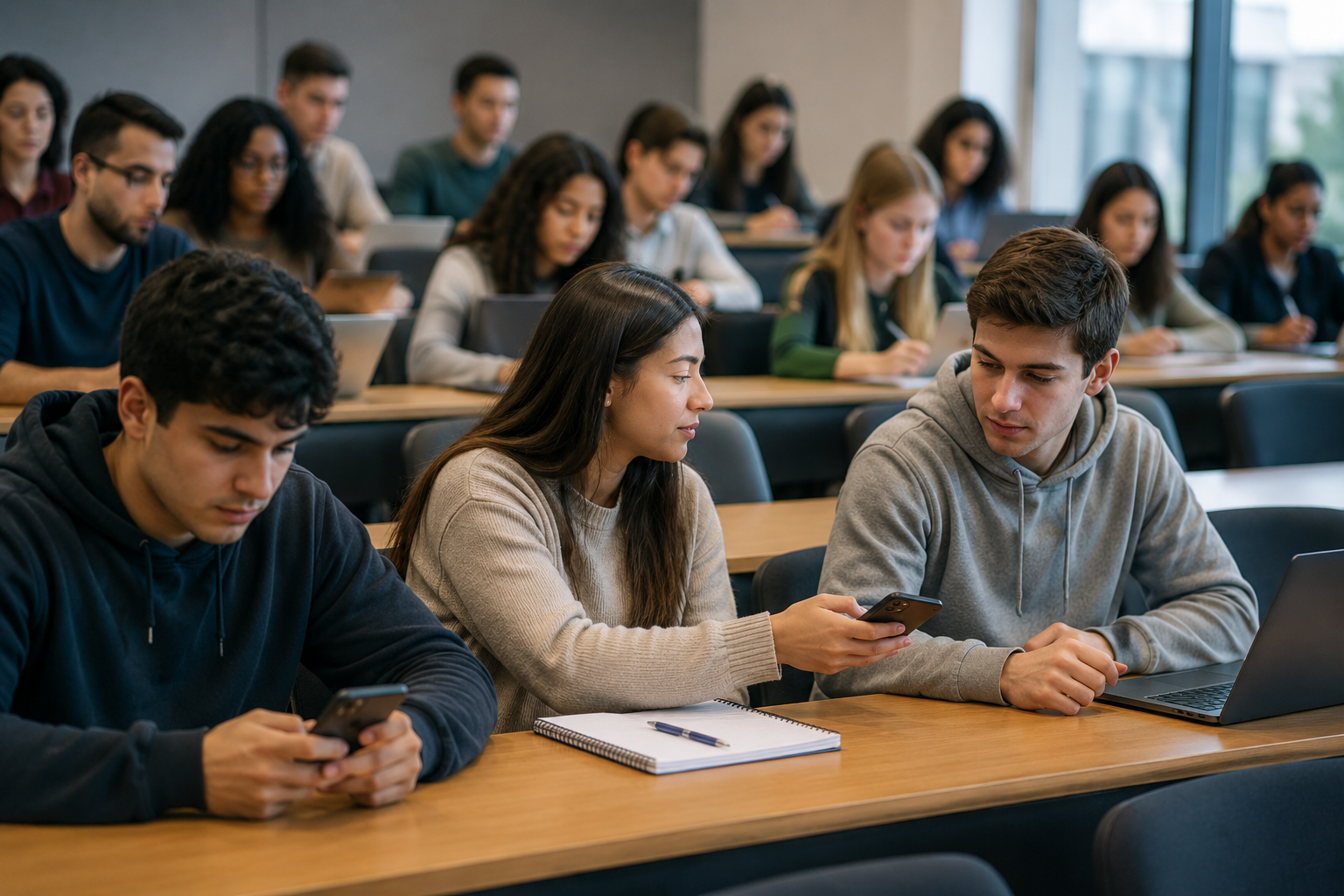
You have 180 students marked present on the register. The room feels half empty. You are not imagining it.
Proxy attendance – where one student marks another as present without them actually being in class – is one of the most common and least addressed forms of academic dishonesty in higher education. It is not new, but as universities adopt digital attendance tools, it has evolved. The methods students use to game the system have kept pace with the technology meant to prevent it.
This article covers what proxy attendance is, why it happens, which methods are most vulnerable to it, and what universities can actually do to stop it.
What is proxy attendance?
Proxy attendance occurs when a student is recorded as present in a class they did not attend, because another student checked in on their behalf. The absent student may be skipping class by choice, dealing with a personal issue, or simply running late.
In practice, proxy attendance takes several forms. A student hands their phone to a classmate who taps the check-in for them. A student shares a QR code screenshot over a group chat. A student calls out “yes” during roll call when their friend’s name is read. The specific mechanism depends on the attendance method in use, but the outcome is the same: the attendance record says the student was there when they were not.
Why proxy attendance happens
It is tempting to frame proxy attendance purely as an ethical failing on the part of students. That framing is not especially useful. Proxy attendance is common partly because many attendance systems make it trivially easy.
When a sign-in sheet is passed along a row, there is no verification that the person signing is the enrolled student. If a QR code is projected on a slide, a student in the room can photograph it and forward it to three friends who are still in bed. In the case roll call is called in a 150-seat lecture hall, an instructor cannot realistically verify that the voice responding belongs to the student on the list.
These are system-design problems as much as they are behavioural ones. Students respond rationally to low-risk opportunities. If the expected cost of helping a friend skip class is near zero, many will do it without much deliberation.
Large class sizes amplify the problem. In a seminar of 15 students, an instructor knows who is in the room. In a lecture of 200, they do not. Anonymity reduces the perceived risk for students considerably.
Why it matters more than most institutions realise
Proxy attendance is often treated as a minor inconvenience – a nuisance that is difficult to eliminate completely and therefore not worth pursuing seriously. This undersells the problem.
Attendance data becomes unreliable
If a meaningful proportion of check-ins are fraudulent, attendance records no longer reflect actual student behaviour. Instructors and academic advisors making decisions based on that data – identifying at-risk students, monitoring engagement, flagging patterns before they become crises – are working with inaccurate information. Research consistently shows a link between class attendance and academic outcomes. That link is only useful if the attendance data is trustworthy. See The impact of student attendance on academic performance for a closer look at what the evidence says.
Compliance records are compromised
Universities that track attendance for regulatory purposes – including institutions enrolling international students on visas with mandatory attendance requirements – risk producing documentation that does not reflect reality. This is not a minor administrative issue. It can have serious consequences in the event of an audit or a visa-related dispute. For more on how attendance intersects with visa compliance, see How the F-1 student visa works and why attendance matters.
Attendance policies lose credibility
When students know that proxy attendance is common and largely unpunished, the policy itself becomes meaningless. Instructors who take attendance seriously find their efforts undermined. Students who do attend every session may reasonably question why they bothered.
Which attendance methods are most vulnerable
Not all attendance methods carry the same level of fraud risk. Understanding where each one is weakest helps in choosing a better alternative. 
Roll call is vulnerable to voice impersonation in large groups. In a hall with hundreds of students, an instructor cannot match every voice to a face. A confident “here” from a neighbouring seat is rarely challenged.
Paper sign-in sheets are among the easiest to exploit. There is no identity verification at the point of signing, sheets circulate without supervision, and a student can sign multiple names before passing the sheet along. The paper record offers no audit trail beyond the signature itself, which is rarely checked against any reference.
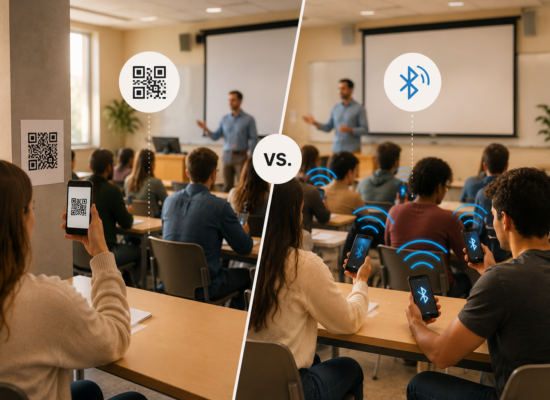
QR codes improved on paper but introduced a new vulnerability: the code is a shareable image. A student in the room can send a screenshot to absent classmates in seconds. Time-limited rotating QR codes reduce the window of opportunity but do not close it entirely if students are quick or organised. For a broader comparison of QR codes against other methods, see Bluetooth attendance tracking for universities: the complete guide.
Link-based or code-based systems without location verification have the same fundamental weakness as QR codes. If the credential needed to check in can be forwarded digitally, it will be.
How to prevent proxy attendance effectively
Eliminating proxy attendance entirely is not a realistic goal. Making it meaningfully harder is. The most effective approaches share a common principle: tie the check-in to something that cannot be easily transferred.
Physical presence verification is the most reliable mechanism. If the attendance system requires the student’s device to be physically within range of a signal that only exists in the classroom, the absent student cannot check in remotely. They would need to send their physical device into the room, which is a considerably higher bar than forwarding a screenshot.
Identity-linked check-in adds a second layer. When each check-in is tied to a verified student account rather than an anonymous tap or a shared code, sharing credentials becomes a meaningful risk. Both students are identifiable in the event of an investigation.
Audit trails and anomaly detection help after the fact. A system that records timestamps and check-in patterns makes irregular behaviour visible. A student who consistently checks in within seconds of the session starting, across multiple courses, on days when other records suggest absence, may be worth a second look.
Transparent enforcement has a deterrent effect independent of the technical measures. Students who know that proxy attendance is taken seriously and that the system makes it detectable are less likely to attempt it in the first place.
The most effective systems combine physical presence verification with identity-linked check-in. This is where Bluetooth-based attendance has a clear advantage over every method that relies on a shareable credential.
How Attendance Radar prevents proxy attendance
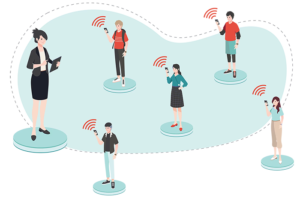
Attendance Radar uses Bluetooth Low Energy to verify that a student’s device is physically within range of the instructor’s signal at the moment of check-in. A student cannot mark themselves present from outside the room because the signal they need to trigger the check-in does not reach them there.
Each check-in is also tied to the student’s individual account, which is verified against the course enrolment list. A student cannot check in under another student’s name, and sharing login credentials to allow a friend to check in remotely carries real risk for both parties.
For online sessions and hybrid classes, the manual code fallback works differently from a QR code. The instructor generates a new six-digit code for each session and delivers it verbally during the live class. Typically it should not be projected as an image, not shared as a file, and not reusable. A student who was not present during the session has no reliable way to obtain it after the fact.
The result is an attendance record that instructors and administrators can actually trust. For a full overview of how the system works, see Bluetooth attendance tracking for universities: the complete guide.
Frequently asked questions
What is proxy attendance? Proxy attendance is when one student marks another as present in a class they did not attend. It can involve handing over a phone, sharing a QR code, answering roll call for an absent classmate, or passing on a session code. The result is an attendance record that does not reflect who was actually in the room.
Is proxy attendance considered academic misconduct? In most universities, yes. Attendance fraud falls under academic integrity policies alongside plagiarism and exam cheating. The specific consequences vary by institution, but students found to have engaged in proxy attendance can face formal disciplinary action.
Which attendance method is hardest to cheat? Bluetooth-based proximity attendance is the most resistant to proxy fraud among commonly available methods. Because check-in requires the student’s device to be physically within range of the instructor’s signal, the absent student cannot check in remotely. Combined with account-level identity verification, it eliminates the main mechanisms that make roll call, sign-in sheets, and QR codes easy to game.
Can a student cheat a Bluetooth attendance system? In theory, a student could hand their unlocked phone to a classmate. In practice, this requires physical presence of the device in the room, coordination between students, and acceptance of the risk that both accounts are identifiable in the system. This is a significantly higher barrier than forwarding a QR screenshot or answering roll call.
How do universities handle proxy attendance when it is discovered? Responses vary. Some institutions treat it as a formal academic integrity violation subject to the same disciplinary process as plagiarism. Others handle it at the faculty level with a warning or grade penalty. The deterrent effect is strongest when policies are communicated clearly and enforcement is consistent.
The bottom line
Proxy attendance is common not because students are particularly dishonest but because most attendance methods make it easy. Sign-in sheets, QR codes, and verbal roll calls all rely on shareable credentials that can be forwarded without the absent student ever setting foot in the building.
The most effective preventive measure is an attendance system that ties check-in to verified physical presence and individual identity. That combination makes proxy attendance genuinely difficult rather than just technically against the rules.
Attendance Radar is free to download. See for yourself how it works in your classroom.
Download Attendance Radar for free today.