

In the modern higher education landscape, the financial health of a university is more closely tied to student engagement than many realize. While there is a common myth that every empty seat in a lecture hall results in an immediate budget cut, the truth is far more complex. University funding relates to attendance on two distinct but interconnected levels:
- The Institutional Level: Where core government grants are often based on broad enrollment headcounts rather than daily participation.
- The Individual Level: Where attendance verification acts as a mandatory “gatekeeper” for student financial aid and tuition revenue.
As institutions face rising operational costs and a global shift toward performance-based funding, the “revenue cascade” triggered by poor attendance can cost universities millions in lost tuition and reputation. Understanding this relationship is vital for any administrator looking to ensure fiscal sustainability.
To navigate these high stakes, modern institutions are replacing outdated manual methods with secure, automated solutions like Attendance Radar, ensuring that every student’s presence is verified and every dollar of funding is protected.
Key Takeaways
- While core government grants are often based on broad enrollment headcounts, attendance verification at the individual level acts as a mandatory gatekeeper for financial aid and tuition revenue.
- Poor attendance triggers a chain reaction of financial losses, known as a revenue cascade, that can cost institutions millions in lost tuition, auxiliary income, and future alumni support.
- Approximately 30% of US states now employ performance-based funding models that link allocations to graduation and retention rates, making attendance a critical factor for long-term institutional survival.
- Global systems, such as the 60% rule in the United States and the COSA process in the United Kingdom, require rigorous attendance verification to prevent the loss or return of student financial aid.
- Moving toward 2026, automated solutions like Attendance Radar are becoming a strategic necessity to provide the secure, real-time data needed to identify at-risk students and protect university margins.
How University Funding Relates to Attendance at the Institutional Level
At the broadest level, the relationship between daily attendance and core university funding is surprisingly loose. For most public universities, government block grants are determined by enrollment figures rather than how many students show up to a specific lecture.
The Enrollment vs. Attendance Distinction
Most government funding formulas are built around enrollment headcounts or Full-Time Equivalent (FTE) metrics.
- In the United States, state funding is typically calculated using FTE enrollment, which represents approximately 30 credit hours of enrollment per student annually.
- The Australian Commonwealth Grant Scheme follows a similar logic, allocating funds based on the number of full-time equivalent domestic students in Commonwealth Supported Places.
- Because these formulas focus on the intent to study rather than daily participation, government agencies generally do not claw back core subsidies if a student stops attending classes after the initial enrollment.
This allows universities to retain their base institutional funding even when physical attendance declines throughout the semester.
The Rise of Performance-Based Funding
While daily attendance may not move the needle on base grants, a significant shift is occurring toward Outcomes-Based Funding (OBF). Currently, approximately 30% of US states link a portion of higher education allocations to institutional outcomes rather than just enrollment.
Under these models, funding ties to metrics such as:
- Graduation rates.
- Student retention.
- Degree completion.
This creates an indirect but powerful financial incentive. Since poor attendance is a leading indicator of a student dropping out, low attendance rates eventually lead to poor retention and graduation scores. Over time, this results in reduced state funding allocations, making attendance a critical factor in institutional survival.
To bridge this gap, Attendance Radar helps universities identify these at-risk students early. By providing real-time data on who is falling behind, administrators can intervene before a student reaches the point of no return, directly protecting the retention metrics that drive performance-based funding.
How University Funding Relates to Attendance at the Individual Level
While institutional block grants provide a foundation of stability, the revenue tied to individual students is far more volatile. At this level, student attendance verification acts as the primary gateway for financial aid disbursement. If a university cannot prove a student is attending, that student’s tuition revenue often never reaches the institution’s bank account.
Global Systems of Attendance Verification
Different regions have established rigorous frameworks to ensure that public funds are only spent on active, participating students.
- The United States Model: Federal financial aid eligibility requires students to demonstrate attendance by the 60% point of each semester. If a student stops attending before this threshold, universities may be required to return up to 50% of the disbursed federal aid to the government. This leaves the student with a direct debt to the university, which is often difficult and costly to collect.
- The United Kingdom System: The UK employs a particularly direct process known as the Confirmation of Student Attendance (COSA). Universities must confirm a student’s presence three times per academic year before tuition fee loans and maintenance payments are released. A failure to confirm attendance by the deadline results in payments being withheld, creating an immediate gap in university revenue.
- European Variations: In France, merit based financial aid is contingent on academic registration and consistent class participation. While considered a softer linkage compared to the US or UK, it still requires institutions to monitor engagement to ensure students remain eligible for their funding.

Solving the Verification Challenge
The administrative burden of these requirements is significant. Relying on manual attendance records or paper sign in sheets creates a high risk of error and fraud, such as proxy signing, where students sign in for absent peers.
This is where Attendance Radar becomes a vital tool for financial compliance. By utilizing secure Bluetooth technology, the system ensures that a student must be physically present within the classroom to check in. This provides administrators with a verifiable, tamper proof digital record that satisfies the strict audit requirements of government agencies. By automating this gatekeeper function, universities can guarantee that their individual student revenue streams remain secure and compliant with national regulations.
How Does Student Attendance Relate to Overall University Revenues
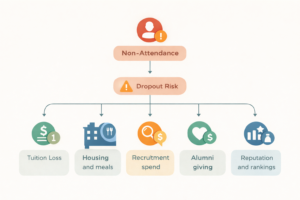
While government block grants provide a foundation of stability, they only tell half the story. The true financial impact of student attendance is the revenue cascade. This is a chain reaction of financial losses that begins with a few missed classes and often ends in a student dropping out entirely.
The Multi-Billion Dollar Dropout Problem
The scale of revenue loss due to student attrition is staggering. Recent research shows that student dropouts cost higher education institutions billions of dollars every year.
- In the United States, the annual cost of student attrition is estimated at approximately $16 billion.
- On an individual level, a single dropout costs a community college an average of $10,000 in tuition and fees.
- At a four year institution, that figure jumps to approximately $21,000 per student.
For a university with 10,000 students, even a 10% dropout rate can result in a direct revenue hit of $1 million to $2 million annually.
Beyond Tuition: The Hidden Financial Hits
The loss of a student does not just mean an empty seat and a missing tuition check. It affects every auxiliary revenue stream the university relies on to balance its books.
- Housing and Meal Plans: When a student leaves, their dormitory room and meal plan contract often go unfulfilled, leaving significant gaps in auxiliary budgets.
- Recruitment Costs: Replacing a lost student is expensive. Institutions must spend heavily on marketing and admissions to recruit a new student to fill that vacant spot.
- Alumni and Future Support: A student who does not graduate is far less likely to become a future donor or support the university endowment.
- Reputation and Rankings: High dropout rates negatively affect university rankings. Lower rankings make it harder to attract high quality applicants and compete for research grants.
Turning the Tide with Attendance Radar
The key to stopping this revenue cascade is early intervention. By the time a student officially withdraws, it is usually too late to save that revenue. Universities need a way to spot the warning signs before the dropout happens.
Attendance Radar provides the analytics and trends that administrators need to protect their bottom line. Instead of waiting for midterm grades, educators can use the real time data from Attendance Radar to identify students whose attendance is beginning to slip.
By seeing these patterns early, student success teams can reach out and provide the necessary support to keep that student on track. This proactive approach does more than just help the student. It directly preserves thousands of dollars in tuition and auxiliary revenue for the institution.
Why Attendance Tracking is a Strategic Priority for 2026
As we look toward 2026, the higher education sector is entering a period of significant structural change. Universities are no longer just academic centers; they are complex organizations that must navigate a “demographic cliff” and tightening fiscal policies. In this environment, attendance tracking has shifted from a simple administrative task to a core strategic pillar for institutional survival.
Navigating the Demographic Cliff
There has been a measurable decline in the number of traditional college aged students. With fewer students entering the system, every single enrollment becomes more valuable. Universities cannot afford to lose students to disengagement. Tracking attendance provides the earliest possible data point to measure that engagement. When a student stops attending, it is the first red flag that they may be at risk of leaving the institution entirely. By prioritizing attendance data, universities can protect their existing student base and maintain stable enrollment levels even as the broader market shrinks.
Demonstrating Value and Accountability
Governments and students alike are demanding greater transparency regarding the value of a degree. In many regions, new regulations for 2026 will tie funding and accreditation even more closely to student outcomes, such as job placement and salary levels. Regular attendance is the strongest predictor of academic success, which in turn drives these long term outcomes. By maintaining high attendance standards, universities can demonstrate to regulators and the public that they are delivering the high quality, engaging education that they promised.
The Role of Technology in Strategic Planning
The challenge for 2026 is how to track this data without adding to the already heavy administrative burden on faculty. Traditional methods are too slow and prone to error to be used for high level strategic decision making. This is why automated systems are becoming the standard.
Attendance Radar is designed for this new era of strategic management. Its ability to track attendance for hundreds of students in under five seconds means that faculty can focus on teaching rather than administrative chores. More importantly, it provides leaders with clean, real time data that can be integrated into broader student success platforms.
When university leaders have access to accurate attendance trends across departments, they can make informed decisions about resource allocation, faculty support, and student intervention programs. In 2026, the institutions that thrive will be the ones that treat attendance not just as a record of who was in the room, but as a strategic asset that protects their mission and their margin.
Conclusion
As we move toward 2026, the relationship between student attendance and university funding is no longer just a matter of classroom management. It has become a fundamental pillar of institutional stability. While the core block grants from governments may remain relatively stable regardless of daily headcounts, the broader financial implications are undeniable.
The individual level of funding is where the most immediate risks reside. With strict verification systems like the 60% rule in the United States and the COSA process in the United Kingdom, attendance is the gatekeeper for tuition revenue. When students stop attending, the revenue cascade begins, leading to millions of dollars in lost tuition, auxiliary income, and future alumni support. Furthermore, as performance based funding models continue to gain traction, poor attendance will increasingly lead to direct reductions in state appropriations.
In this high stakes environment, the institutions that thrive will be those that treat attendance data as a strategic asset. Relying on outdated manual processes is no longer a viable option for a modern university.
Secure Your Funding with Attendance Radar
To protect your institution’s revenue and ensure long term fiscal health, you need a solution that is fast, secure, and compliant. Attendance Radar provides the Bluetooth powered verification and real time analytics necessary to stay ahead of the revenue cascade. By automating the tracking process, you can identify at-risk students early, simplify financial aid audits, and allow your faculty to focus on what they do best: teaching.