
The high cost of college dropouts is a growing concern for both higher education institutions and the students they serve. While graduation rates have shown complex trends over the past few decades, the financial and personal stakes of leaving school without a degree have never been higher. To address this, modern institutions are turning to innovative technology like Attendance Radar to identify disengaged students early and intervene before they decide to leave. This post explores the significant financial impacts of student attrition and the proactive measures schools can take to improve retention.
Key Takeaways
- Universities face a massive financial drain, with student dropouts costing the higher education system more than $16 billion every year in lost tuition and fees.
- Finishing a degree is vital for long-term financial security, as college graduates earn a median of $1.2 million more over their careers than those who only complete high school.
- Leaving school early creates a severe debt trap; non-graduates are nearly six times more likely to default on their student loans and represent 72% of all loan defaults.
- The primary drivers for leaving school have shifted, with mental health and emotional stress now ranking as the top reasons students consider dropping out, followed closely by financial pressure.
- Early intervention is one of the most effective solutions, as automated attendance tracking through tools like Attendance Radar can reduce dropout rates by 21% by flagging disengagement early in the semester.
Cost of Dropouts to the University
When a student leaves college before finishing their degree, the university faces a complex financial challenge. These losses are not just about missing tuition payments. Instead, they include a mix of direct revenue gaps and hidden operational costs that drain institutional resources.
Direct Revenue Loss
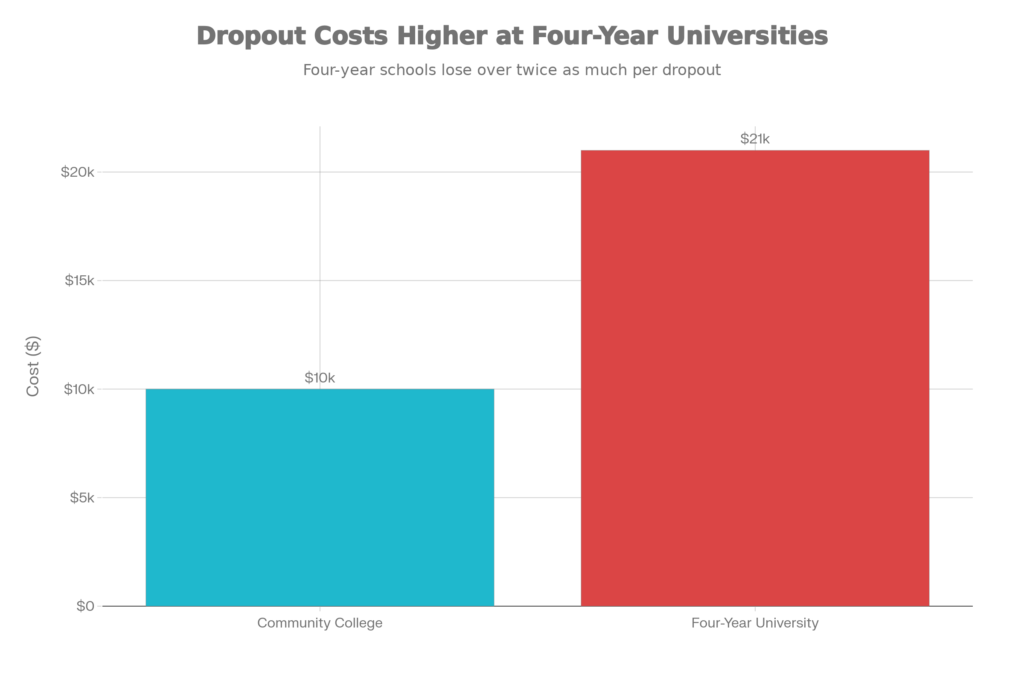
The most immediate impact is the loss of tuition and fees. Nationally, student dropouts cost the higher education system more than $16 billion every year. This financial burden varies depending on the type of school the student attends. According to the National Student Clearinghouse Research Center:
- Community colleges lose about $10,000 for every student who drops out.
- Four-year universities lose an average of $21,000 per student.
- A typical university with 10,000 students and a 10% dropout rate can lose between $1 million and $2 million annually.
Performance-Based Funding
Modern universities are moving away from funding models based only on enrollment numbers. Instead, many states now use outcomes-based or performance-based funding. This shift means that a significant portion of a university budget depends on student success metrics. This was covered more in depth in our article titled: “How University Funding Relates to Attendance”.
The Loss of State Appropriations Approximately 30% of states in the U.S. now link government funding directly to graduation and retention rates. When a student drops out, the university does not just lose that individual’s tuition. It also risks a reduction in the state grants that keep the institution running. Because dropouts lower a school’s overall success score, the university may receive less money in the following budget cycle.
Hidden Costs and Resource Inefficiency
Beyond the missing tuition, universities must deal with several indirect expenses that often go unnoticed.
The Recruitment Treadmill
Universities must spend a significant amount of money to find and enroll new students. Recruitment spending often ranges from $500 per student. Approximately 30% of these costs are used simply to replace students who have already left. This creates a perpetual cycle where schools must admit more students than they actually need to stay afloat.
Wasted Academic Resources
Unpredictable enrollment makes it difficult for schools to plan for housing, equipment, and course sections. Students who leave after one or two years use expensive resources like academic advising and library facilities without providing a long-term return.
Rankings Damage
Schools must publicly report their retention and graduation rates. These numbers heavily influence major rankings like U.S. News and World Report. Low rates make future recruitment even more difficult and expensive.
Lost Alumni Potential
Students who drop out rarely become active, degree-holding alumni. This means the university loses decades of potential donations and professional networking. A single dropout cohort represents a massive loss in future fundraising and institutional advocacy.
Cost of Dropouts to Students
The personal financial consequences of leaving college early can last a lifetime. For many students, dropping out triggers a debt crisis without the benefit of a degree to help pay it off.
The Lifetime Earnings Gap
The difference in earnings between those who finish college and those who do not is significant. According to Georgetown’s University, “The College Payoff: More Education Doesn’t Always Mean More Earnings”:
- Full-time full-year workers with a bachelor’s degree earn a median of $2.8 million during their career.
- In contrast, workers with only high school degrees earn a median of $1.6 million during their career, 43% less.
- This creates a $1.2 million financial disadvantage for those who drop out.
- Moreover, this doesn’t consider those with Master’s, Doctoral’s and professional degree holders that earn a median of $3.2 million, $4 million and $4.7 million respectively.
The Student Loan Debt Trap
Many students who leave school find themselves in a difficult financial position. They owe money for their education but lack the credential needed to get higher-paying jobs.
- The average dropout leaves school owing $13,929.65 in student loans.
- This is nearly half of the average debt that graduates carry, yet dropouts do not have a degree to show for it.
Higher Risk of Default
The most alarming part of the dropout crisis is the rate of loan default. According to the US Department of Education:
- About 53% of dropouts with student debt are not making any payments toward their loans.
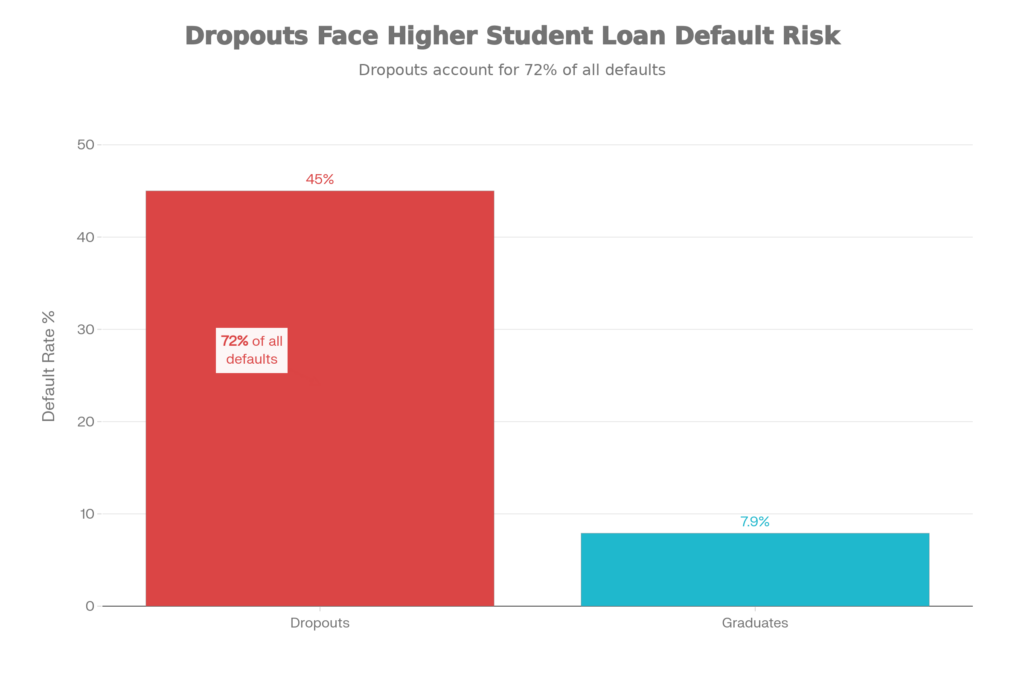
- An estimated 45% of college dropouts default on their student loans.
- In contrast, only 7.9% of graduates face default, around 6 times less.
Moreover, according to the National Center for Education statistics, 72% of loan defaults come from non-graduates.
The consequences of default are severe. About 60% of dropouts with debt report that it has damaged their credit scores. They may also face wage garnishment or have their tax refunds withheld by the government.
Stress and Mental Health
Financial worry often leads to deeper personal struggles. Ellucian reports that 78% of financially stressed college students report negative mental health impact. This stress makes it even harder to succeed in school, with 61% of students reporting academic performance declines. Heartbreakingly, among those students considering dropping out, 57% report having to choose between university expenses and basic needs such as food and clothing.
How Has the Cost of Dropouts Changed Over Time?
The history of college completion in the United States is more complex than a simple decline. While many assume that dropout rates are higher than ever, the data shows two distinct periods: a significant decline from the 1970s through the early 1990s, followed by a reversal and improvement since the mid-1990s.
The Decline Period: 1970s–1990s
Between the 1970s and early 1990s, college completion rates dropped substantially. This decline happened primarily because institutional characteristics changed, not because students were less prepared.
- During this 20 year period, the ratio of bachelor’s degree holders to people with only “some college” fell consistently.
- The decline was most severe at public “non-top 50” universities that expanded enrollment while cutting instructional resources.
- These budget shifts led to worse student-to-faculty ratios, making it harder for students to finish their degrees.
During this same time, high school completion actually improved. High school dropout rates fell from 6.2% in 1980 to 4.1% in 1990. This suggests that while more students were graduating high school and starting college, a smaller percentage of them were actually finishing their higher education.
The Reversal: 1990s–2010s
Starting in the early 1990s, the trend reversed. Completion rates began to climb across public, private, elite, and non-elite institutions for both men and women.
- The 1991 entering cohort had a six year graduation rate of 52.0%.
- By the 2010 entering cohort, that rate rose to 59.7%, a gain of 7.7 percentage points.
- Top-50 public universities saw graduation rates jump from 82.1% to 90.7% between the 1992 and 2004 cohorts.
- Community colleges also saw gains, rising from 19.6% to 24.3% in that same timeframe.
However, for-profit colleges did not share in this success. Graduation rates at for-profit schools actually declined during this period, even as the sector grew.
The Role of Grade Inflation
Research into why graduation rates rose despite several negative economic trends suggests a controversial answer: grade inflation. Almost all identifiable factors during this period should have led to lower graduation rates:
- Lower Student Preparation: Average math test scores for entering students fell from the 59th to the 56th percentile between 1992 and 2004.
- Fewer Resources: Student-to-faculty ratios increased from 39.35 to 40.44.
- Higher Costs: Tuition adjusted for inflation rose by over 300% since 1987.
- Less Study Time: Students spent less time studying and more time working for wages.
Despite these barriers, first-year GPAs increased. Statistical analysis reveals that higher GPAs explain between 66% and 96% of the graduation rate improvements since 1990. This suggests that nearly all of the improvement in completion is due to higher grades rather than better student performance.
Recent Trends: 2018–2025
The most recent data shows that graduation rates continue to rise. For the 2018 entering cohort, the six year completion rate reached 61.1%. By 2024, graduation rates at public four-year institutions reached 71%, while private nonprofits hit 76%.
Solutions: Evidence-Based Strategies to the Cost of Dropouts
Understanding the cost of dropouts is critical, but dropout is preventable. Research demonstrates that strategic, data-driven interventions can significantly reduce attrition rates.
Early Warning Systems and Attendance Tracking
One of the most powerful tools for prevention is digital attendance tracking. Because students who stop attending class often drop out within weeks, monitoring attendance serves as a leading indicator of risk.
- Digital Efficiency: Systems like Attendance Radar use Bluetooth verification to track attendance for hundreds of students in seconds, providing real-time analytics early in the semester.
- Proven Results: Institutions using digital tracking have seen a 21% reduction in dropout rates compared to those using manual methods.
- Engagement Link: Students who engage with campus activities and are monitored through these systems are over 50% more likely to persist to the next year.
Personalized Support and Mentoring
Data works best when it triggers timely human intervention.
- Proactive Advising: Academic advising is a high-return intervention, especially when advisors discuss financial plans with students.
- Peer Mentoring: Programs that pair students with mentors, especially those who have successfully navigated similar academic struggles, can dramatically improve retention.
- Holistic Services: Effective institutions integrate counseling services directly with academic teams to support the “whole” student.
Conclusion
The impact of college dropouts extends far beyond simple financial metrics. Universities currently lose billions of dollars annually in tuition revenue and state appropriations, while also facing reputational damage that makes future recruitment more expensive. For individual students, the consequences can be even more severe, including a significant lifetime earnings gap and a high risk of defaulting on student loans without the benefit of a degree credential.
While completion rates have improved in recent years, much of this gain is statistically linked to grade inflation rather than actual increases in student learning. Today, students face intensifying pressures, particularly regarding mental health and financial stability, that continue to drive dropout rates. Addressing these root causes through better support systems, specifically automated solutions like Attendance Radar that transform attendance data into actionable prevention, is essential for ensuring that higher education remains a viable path to long-term success.