
Why attendance matters beyond the classroom
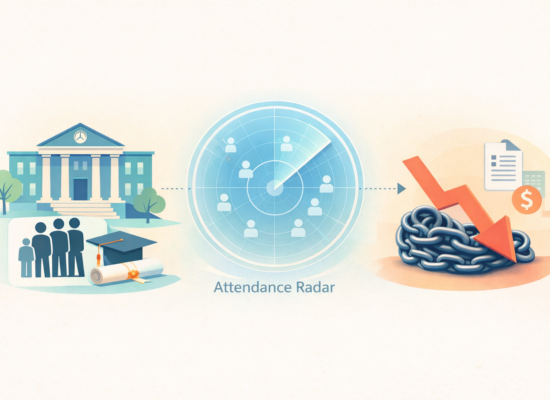
In conversations about graduation rates, attendance doesn’t always take center stage. Yet it’s one of the most reliable early signals of academic risk.
In higher education, attendance often feels like a small detail in the bigger picture. But behind every class session missed is a potential missed opportunity, not just for learning, but for long-term academic success.
Across universities and colleges, there’s growing recognition that attendance isn’t just a sign of engagement, it’s a measurable predictor of whether students complete their degrees. For faculty, administrators, and policy makers focused on improving graduation rates, understanding the connection between attendance and student outcomes is essential.
This blog explores the evidence behind that link. We’ll look at what the research shows, why the connection exists, and how universities can use attendance data to support student success.
What Research Says About Attendance and Graduation
Research consistently shows that regular class attendance is a strong predictor of academic success and graduation outcomes.
Let’s look into some of the these examples:
1) Attendance and academic performance go hand in hand
A 2023 study found that students who attended class more frequently consistently achieved higher grades, even when attendance wasn’t directly incentivised or required. The effect held across disciplines, suggesting that presence itself plays a meaningful role in learning outcomes.
Read this article for a deep dive into the impact of student attendance on academic performance.
2) Poor attendance strongly correlates with failure to graduate
In one longitudinal study, students who missed more than 20% of class days were far less likely to graduate, while those with higher attendance consistently completed their programs. The researchers found that attendance patterns alone were often enough to predict final outcomes.
3) Early attendance patterns predict long-term outcomes
Even in earlier stages of education, attendance has long been linked to persistence and graduation. According to the U.S. Department of Education, students with high absenteeism in earlier grades are more likely to face academic struggles and eventually drop out. This trend often continues into higher education.
4) Attendance is foundational – even when other factors are controlled
Socioeconomic background, academic preparation, and support systems all matter, but research consistently shows that attendance is a foundational behaviour that supports academic success. Even among students with similar backgrounds, those with stronger attendance records are more likely to graduate.
Why attendance impacts graduation: three key mechanisms
The link between attendance and graduation isn’t just statistical, it’s structural. Regular class attendance supports the academic, behavioral, and institutional factors that help students stay on track. Below are three key mechanisms that explain why attendance plays such a decisive role in student success.

- Engagement and comprehension
Students who regularly attend class are more likely to understand the material, participate in discussions, and retain information. This improves performance not just on exams, but across assignments, group work, and projects that contribute to final grades. Over time, consistent attendance builds confidence and academic momentum, two qualities that make a student more likely to persist through their program.
- Early warning and intervention
Attendance patterns can act as an early indicator of disengagement or struggle. When students start missing classes, especially in the early weeks of a course, it can signal that they’re falling behind, facing external pressures, or losing motivation. Institutions that track attendance systematically are better positioned to step in early with support, whether that’s academic help, financial aid guidance, or wellbeing check-ins.
- Predictable behaviours lead to predictable outcomes
Consistent attendance reflects habits that are strongly associated with persistence: time management, routine, and personal accountability. These behaviors often correlate with higher retention and graduation rates. On the other hand, chronic absenteeism may reflect deeper challenges, financial stress, lack of support, or disconnection from the university community that increase dropout risk.
Case studies: attendance, interventions, and student success in action
Understanding the link between attendance and graduation is stronger when we look at how institutions have used data‑driven interventions and support systems to improve student outcomes. Below are practical examples where focusing on student engagement, including attendance, helped support retention, persistence, and ultimately degree completion.
-
Institutional strategies improve retention and graduation outcomes
A multi‑year evaluation of student success initiatives found that comprehensive, coordinated strategies designed to support retention, including early identification of at‑risk students and targeted academic support, were linked with improved persistence and graduation rates. These approaches often include tracking behaviours such as class attendance, grades, and engagement signals to inform timely interventions.
This type of evidence shows that attendance tracking does not work in isolation but becomes part of a larger cosystem of student success initiatives that help students stay on track toward graduation.
-
Case examples from higher education institutions
An analysis of progression initiatives across Irish higher education institutions found a range of interventions designed to improve student outcomes, including attendance monitoring, academic advising, and data‑informed support systems.
While the focus was not solely on attendance, these case studies demonstrate how systematic tracking and support structures correlate with stronger progression rates.
These examples highlight that when universities commit to understanding and acting on attendance and participation data, they are better positioned to support students before they disengage entirely.
-
Predictive insights and early intervention
Research into student retention strategies emphasizes the value of data analysis (including attendance records) in identifying students at risk of dropping out. Machine learning and other predictive models can analyze patterns of attendance and participation alongside other academic data to provide early warnings and enable personalised interventions. By acting on early signals such as irregular attendance, institutions can reduce downstream risks to graduation.
While this research focuses on advanced methods, the underlying principle is the same: attendance trends are actionable data that, when paired with support systems, improve the likelihood that students stay enrolled and complete their degrees.
These examples demonstrate that attendance matters not only as an isolated metric but as part of broader institutional practices that support student success. Universities that pay attention to attendance patterns, integrate them into their student support frameworks, and act early on warning signals are better positioned to improve both retention and graduation outcomes.
Attendance policies that support graduation goals
Well‑crafted attendance policies do more than require students to show up, they create structures that support engagement, belonging, and early intervention. Research shows that when institutions formalize expectations around attendance, students are more likely to participate regularly and stay connected to their coursework, which supports persistence and progression.
It’s equally important that policies balance accountability with flexibility. Mandatory attendance rules can be counterproductive if they don’t allow legitimate exceptions or if they push students to attend while unwell, which research has shown can have unintended consequences. Policies that emphasize communication, support, and clear expectations rather than strict punishment alone, create the conditions for better academic engagement and long‑term persistence.
How data and tools can help
Even the best policies fall short if institutions lack visibility. This is where data, and the tools that help collect and interpret it, play a critical role.
Tracking attendance consistently provides an early signal when a student may be struggling. When used alongside academic performance and advising data, it becomes a key input in early warning systems. For DSOs, support staff, and faculty, this allows for faster intervention and more targeted support.
Digital tools like Attendance Radar help universities gather accurate, real-time attendance data with minimal classroom disruption. Platforms like these make it easier to monitor patterns, identify gaps, and ensure students stay visible to the people best positioned to help.
When attendance data is easy to collect and easy to act on, it becomes more than a record, it becomes a resource.
Conclusion: Attendance is more than a metric
Improving graduation rates is one of the most important goals in higher education, but often, the earliest signals of risk are also the simplest. As research consistently shows, attendance is one of the clearest predictors of student success.
From academic performance and classroom engagement to early warning systems and institutional planning, tracking attendance offers valuable insight into how students are progressing and where support may be needed. Universities that treat attendance as part of a broader student success strategy, rather than a disconnected policy, are better equipped to respond early and improve long-term outcomes.
For staff, administrators, and policy makers, the next step is ensuring that attendance data is accessible, reliable, and integrated into everyday decision-making. Whether you’re reviewing policy, designing support systems, or looking for ways to improve retention, attendance is a practical place to start.
For more on how tools like Attendance Radar make this process easier, or to explore more research-backed insights on student success, visit the Attendance Radar blog.